
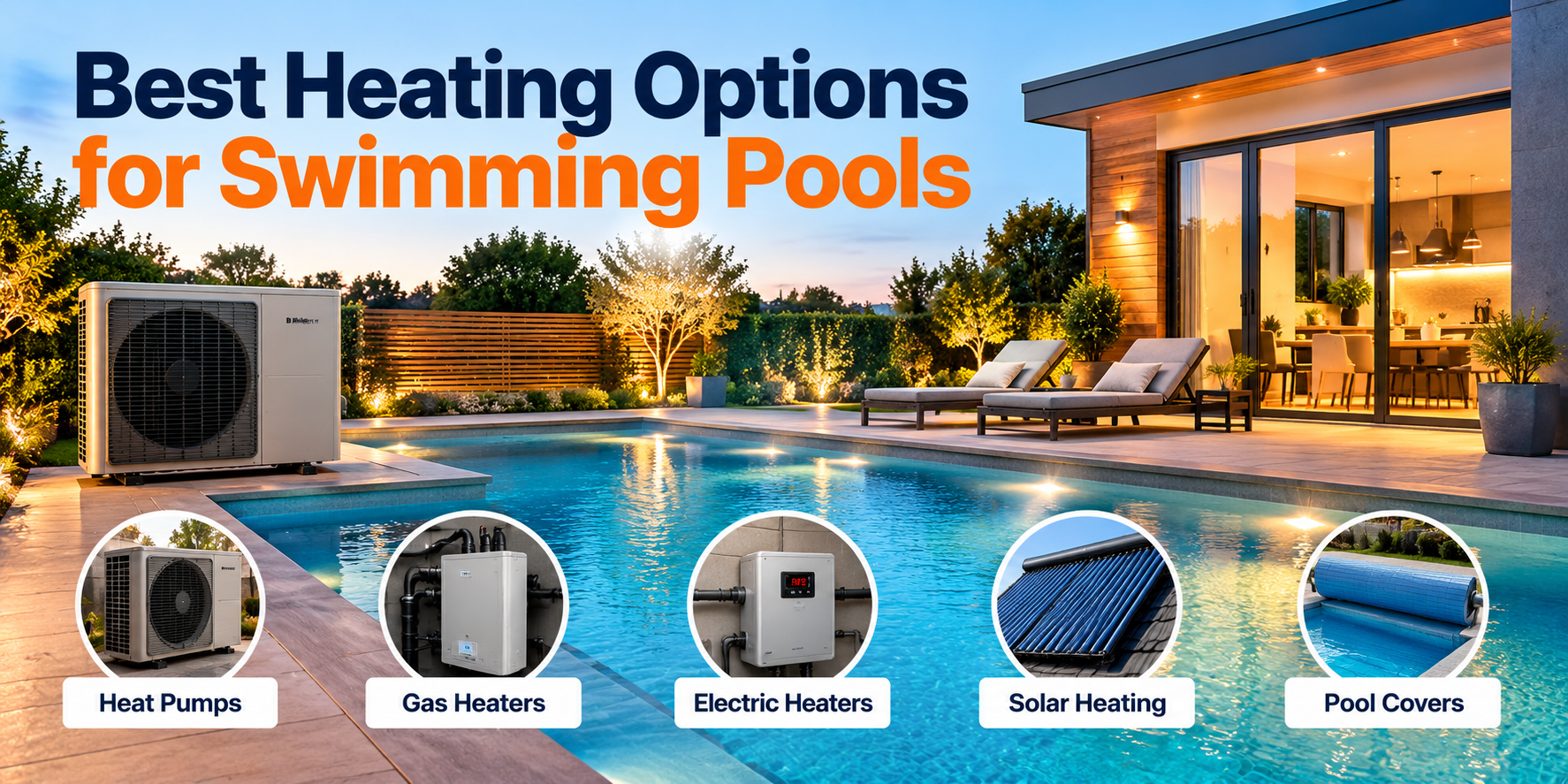
A swimming pool can be a fantastic addition to a home, but the UK climate means that water temperature needs careful consideration. Even during summer, an unheated outdoor pool can quickly become too cold for comfortable swimming.
Choosing the right swimming pool heating system depends on the size of the pool, whether it is indoors or outdoors, how frequently it will be used, the desired water temperature and the property’s existing energy systems. Running costs and heat retention are equally important.
Here are the main pool heating options homeowners should consider.
1. Air Source Heat Pumps
Air source heat pumps are one of the most popular options for modern swimming pools. Instead of directly generating all their heat, they extract heat from the surrounding air and transfer it into the pool water.
This can make them considerably more energy efficient than conventional electric resistance heaters.
Modern pool heat pumps can operate in relatively cool conditions, although their efficiency generally improves as the outside air temperature rises.
They are particularly suitable for homeowners who want to maintain a relatively consistent pool temperature throughout the swimming season.
The main considerations are the initial installation cost, suitable outdoor positioning, airflow around the unit and potential operating noise.
2. Ground Source Heat Pumps
Ground source heat pumps collect naturally occurring heat from the ground and transfer it into the heating system.
They can provide efficient, consistent heating because underground temperatures fluctuate less than outside air temperatures.
However, installation is significantly more involved than installing an air source system. Ground loops require considerable external space or boreholes, making ground source systems more suitable for larger projects, new builds or properties already incorporating ground source heating.
For a swimming pool alone, the installation cost may be difficult to justify. Where a property already uses ground source technology, however, integrating pool heating may be worth investigating.
3. Gas Pool Heaters
Gas heaters have traditionally been used where fast pool heating is required.
Rather than gradually maintaining temperature, a correctly sized gas heater can raise water temperature relatively quickly. This can be useful for pools that are used occasionally rather than continuously.
Their main disadvantage is running cost and reliance on fossil fuel. The suitability of gas also depends on the property’s available supply and the wider heating design.
For homeowners prioritising rapid heating over maximum energy efficiency, gas can still be an option worth considering.
4. Electric Resistance Heaters
Electric pool heaters work by passing water across an electrically heated element.
They are compact, relatively straightforward and can provide predictable heating regardless of outdoor air temperature.
However, directly converting electricity into heat can make them expensive to operate for larger swimming pools.
Consequently, electric heaters are generally more appropriate for smaller pools, spas, hot tubs or situations where heating is only required occasionally.
For a large outdoor pool that is maintained at a comfortable temperature for months, a heat pump will often be more practical.
5. Solar Pool Heating
Solar thermal pool heating uses energy from sunlight to warm circulating pool water.
Water is normally pumped through solar collectors before returning to the swimming pool. Once installed, operating costs can be relatively low because the main energy source is sunlight.
The limitation in the UK is obvious: solar availability changes substantially throughout the year.
Solar pool heating can therefore work particularly well as a supplementary system rather than the only source of heat. Roof orientation, available collector area, shading and the swimming season all influence its effectiveness.
6. Solar PV Combined With a Heat Pump
Another approach is combining photovoltaic solar panels with an electrically powered swimming pool heat pump.
Solar PV generates electricity rather than directly heating pool water. The electricity generated can contribute towards operating the heat pump and other household systems.
The two technologies can complement each other particularly well because outdoor swimming pools often require the most heating during sunnier months when solar electricity production is also higher.
However, the actual financial benefit depends on system size, electricity consumption, available roof space and how much solar generation is available when the pool equipment is operating.
Pool Covers Can Be Just as Important as the Heater
Choosing an efficient heater is only half the solution.
Outdoor swimming pools lose substantial heat from the water surface, particularly through evaporation. Wind and cooler night-time temperatures can increase these losses.
A properly fitted swimming pool cover can help retain heat and reduce evaporation. Depending on the pool design, options include floating covers, insulated covers and automatic pool covers.
This means investing in heat retention can reduce the amount of energy the heating system needs to supply.
Indoor Pools Need a Different Approach
Indoor swimming pools present different heating challenges.
The water needs heating, but the surrounding room also requires careful temperature, humidity and ventilation management. Warm pool water continuously releases moisture into the indoor environment.
Without appropriate ventilation and dehumidification, condensation can affect windows, walls, ceilings and potentially the building structure.
An indoor pool should therefore be designed as a complete environmental system rather than treating water heating separately.
How Much Heating Does a Swimming Pool Need?
There is no single heater size suitable for every swimming pool.
The heating requirement depends on factors including:
- Pool volume and surface area
- Indoor or outdoor installation
- Desired water temperature
- Typical outdoor temperature
- Exposure to wind
- Amount of shade
- Swimming season
- Frequency of use
- Whether a pool cover is installed
- Required heating speed
An oversized system can add unnecessary installation expense, while an undersized system may struggle to achieve or maintain the desired temperature.
Professional heat-loss calculations are therefore preferable to choosing equipment based solely on pool volume.
Planning Heating During Pool Construction
Heating should ideally be considered during the initial swimming pool design rather than added as an afterthought.
Plant-room space, pipework, electrical supply, drainage, filtration equipment and the location of heat pumps or other heating equipment can then be coordinated properly.
Norfolk Building designs and constructs swimming pools across Norwich, Norfolk and Suffolk, where heating, filtration, electrics, groundworks and surrounding landscaping can all be considered as part of the wider pool project.
For many UK outdoor pools, an appropriately sized air source heat pump combined with a good-quality pool cover can offer a practical balance between comfort and energy efficiency. However, the best solution ultimately depends on the individual property and how the pool will actually be used.
FAQs
What is the most energy-efficient way to heat a swimming pool?
Heat pumps are often among the most energy-efficient conventional options because they transfer existing environmental heat rather than producing all the required heat directly. Actual efficiency depends on conditions, system design and pool heat loss.
Can solar panels heat a swimming pool?
Yes. Solar thermal collectors can directly contribute to pool heating, while solar PV panels can generate electricity to help power a heat pump. Performance depends heavily on available sunlight, collector or panel size and the property’s installation conditions.
Should I leave my pool heater running all the time?
Not necessarily. The most efficient operating strategy depends on the heating system, insulation, pool cover, desired temperature and frequency of use. Heat pumps often work efficiently when maintaining a relatively stable temperature rather than repeatedly heating very cold water.
How can I reduce swimming pool heating costs?
Use an effective pool cover, reduce unnecessary heat loss, maintain equipment correctly and choose an appropriately sized heating system. Protecting an outdoor pool from excessive wind can also help reduce heat loss.
Is heating different for indoor and outdoor swimming pools?
Yes. Outdoor pools are strongly affected by weather, evaporation and wind. Indoor pools require water heating alongside room heating, ventilation and humidity control. Indoor pool design therefore needs particular attention to condensation and dehumidification as well as water temperature.